
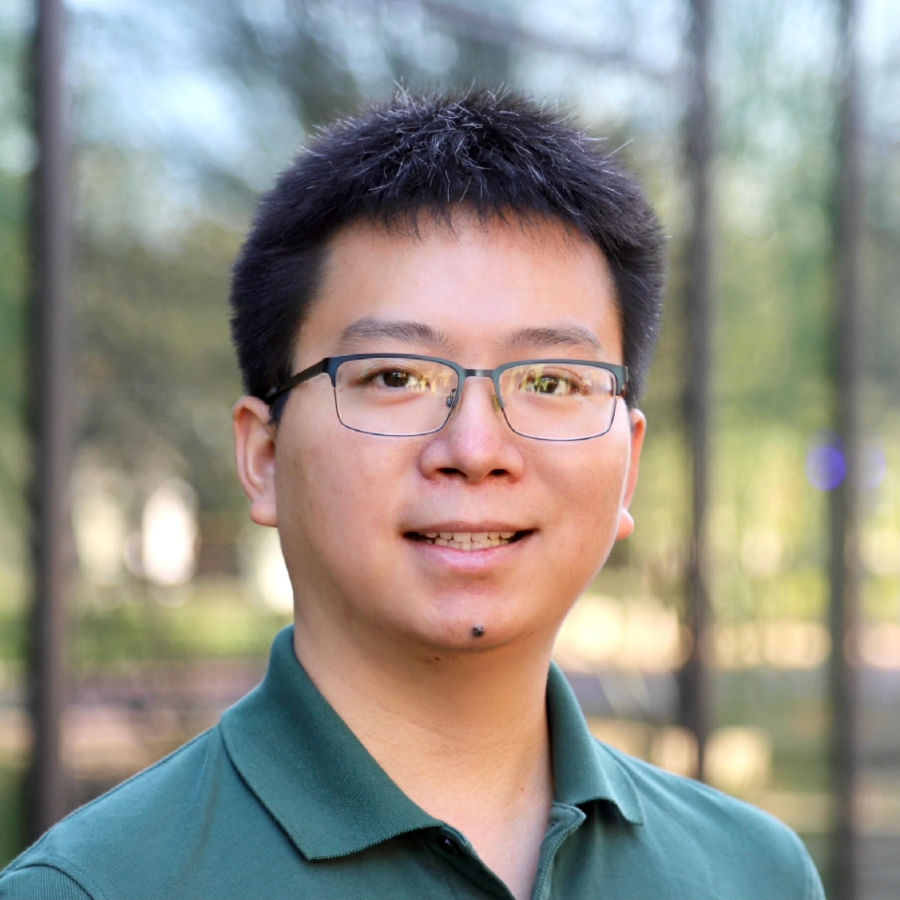
Pan Xu, PhD, assistant professor of Biostatistics, Electrical and Computer Engineering, and Computer Science, has been selected as the recipient of the National Science Foundation’s Faculty Early Career Development Program (CAREER) Award.
Xu will use the funding to develop new methods for training AI systems through off-dynamics reinforcement learning, with the goal of improving their reliability in medical and other high-stakes settings, where data may be limited and poor decisions may lead to serious consequences.
Reinforcement learning (RL) is an area of AI that studies how to make a sequence of decisions over time, with each decision affecting future outcomes. “Many RL methods assume that the environment in which a system is trained is the same as the environment in which it will be deployed,” Xu said. “When these environments differ, the system’s performance can deteriorate,” he continued.
To address this challenge, Xu and a team of students will use data from source environments, such as simulations, historical records, or large public datasets, to teach AI systems general patterns about how decisions affect future outcomes .
They will then combine this information with limited data from a target environment to help the systems operate more reliably under conditions that differ from those encountered during training. This approach could reduce reliance on large datasets collected from each specific target environment, and the need for slow or potentially unsafe trial-and-error interactions in real-world settings.
“This support gives my group the opportunity to build foundations for RL systems that can be trained in accessible environments and deployed more reliably in real-world settings where data are limited and mistakes can be costly,” Xu said.
Students will get to collaborate with healthcare professionals, develop rigorous machine learning theory and design efficient reinforcement learning algorithms, then evaluate those methods on both standard benchmarks and real-world healthcare datasets, and make the research reproducible.
“The award is both a recognition of our research direction and an investment in the students who will help shape the next generation of trustworthy AI,” Xu said.
The NSF CAREER award supports early-career faculty members who are emerging leaders in research and education, aiming to advance the mission of their department or organization.